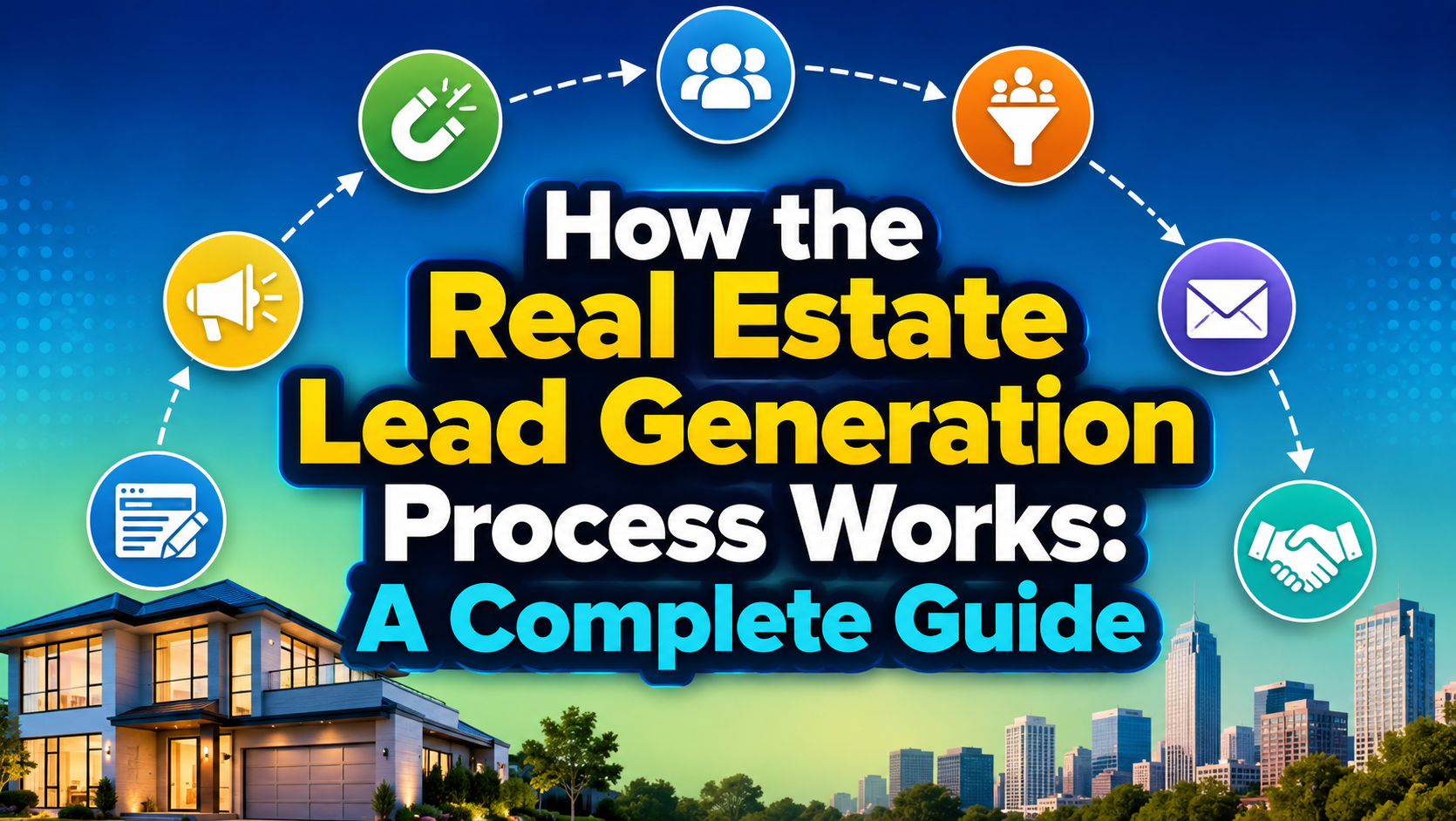
Generating a steady flow of potential clients is one of the biggest challenges for real estate agents, teams, and brokerages. While referrals and repeat business remain valuable, a predictable real estate lead generation process can help businesses consistently attract new buyers, sellers, and investors.
But generating a lead is only the beginning. The real goal is to attract the right prospects, qualify them, build trust, follow up consistently, and ultimately turn them into appointments and clients.
In this guide, we’ll explain how the real estate lead generation process works, the channels that generate leads, how leads are qualified, and how businesses can improve conversion rates.
What Is the Real Estate Lead Generation Process?
The real estate lead generation process is the systematic approach used to attract potential buyers, sellers, investors, or property owners and turn their interest into actionable sales opportunities.
A typical process looks like this:
Attract → Capture → Qualify → Nurture → Convert → Follow Up → Close
Each stage has a specific purpose. Attracting thousands of visitors is not enough if those visitors aren’t interested in buying or selling property. Similarly, generating qualified leads won’t produce results if there is no effective follow-up strategy.
A successful process connects marketing, lead qualification, sales, and customer relationship management into one continuous funnel.
Why Is a Real Estate Lead Generation Process Important?
Real estate businesses need a consistent source of opportunities to maintain predictable growth.
Without a structured process, agents may rely heavily on:
- Referrals
- Cold calling
- Open houses
- Networking
- Purchased lead lists
- Social media inquiries
- Walk-in prospects
These methods can work, but relying on only one or two channels can make lead flow unpredictable.
A well-designed lead generation process helps real estate professionals:
- Generate leads consistently
- Reach specific audiences
- Identify high-intent prospects
- Reduce wasted marketing spend
- Improve lead follow-up
- Increase appointments
- Measure campaign performance
- Build a predictable sales pipeline
The focus should not simply be on generating more leads. It should be on generating better-quality leads that have a realistic opportunity to become clients.
The 7 Stages of the Real Estate Lead Generation Process
1. Identify Your Target Audience
The first step is determining exactly who you want to attract.
A real estate agent serving first-time homebuyers will need a different strategy from a luxury property specialist targeting high-net-worth buyers.
Your audience might include:
- First-time homebuyers
- Home sellers
- Real estate investors
- Luxury property buyers
- Property owners
- Relocating families
- Commercial property buyers
- Land investors
- Homeowners considering selling
You should also define your geographic market.
For example, instead of targeting everyone searching for real estate, a campaign could focus on:
Home sellers in Miami
or:
First-time homebuyers in Dallas
The more precisely you define your audience, the easier it becomes to create relevant marketing campaigns.
2. Attract Potential Real Estate Leads
Once you know your audience, the next step is attracting people who may need your services.
There are several channels that can contribute to real estate lead generation.
Search Engine Optimization
SEO helps real estate businesses appear when potential clients search for relevant information on Google and other search engines.
Examples include:
- Homes for sale in [city]
- Best neighborhoods in [city]
- How to sell a house
- How much is my home worth?
- Real estate agent near me
- Best realtor in [city]
Content targeting these searches can bring potential buyers and sellers to your website.
Paid Advertising
Google Ads and social media advertising can help businesses reach people based on location, interests, demographics, and search behavior.
Paid campaigns can be particularly useful when a real estate business wants to generate leads faster than organic search alone.
Social Media
Platforms such as Facebook, Instagram, YouTube, and LinkedIn can help real estate professionals build awareness and generate inquiries.
Useful content can include:
- Property tours
- Market updates
- Neighborhood guides
- Buyer tips
- Seller advice
- Mortgage information
- Local market statistics
- Success stories
Local SEO
Local SEO is especially important for real estate businesses because property searches are highly location-specific.
Optimizing your Google Business Profile, website, local landing pages, reviews, and location-based content can help you reach prospects searching for real estate professionals in a specific market.
3. Capture the Lead
Getting someone to your website is only part of the process.
You also need a way to turn website visitors into identifiable prospects.
Common lead-capture methods include:
- Contact forms
- Property inquiry forms
- Home valuation forms
- Consultation requests
- Downloadable guides
- Newsletter subscriptions
- Chat
- Phone calls
- Appointment forms
Your landing page should make the next step obvious.
For example:
“Get a Free Home Valuation”
can be more compelling for a potential seller than a generic:
“Contact Us.”
The offer should match the visitor’s intent.
4. Qualify Real Estate Leads
Not every lead has the same value.
One person may be ready to purchase a home within 30 days, while another may simply be researching the market.
Lead qualification helps separate high-intent prospects from early-stage inquiries.
You can qualify leads based on factors such as:
- Buying or selling intent
- Location
- Property type
- Budget
- Timeline
- Financing status
- Investment goals
- Property value
- Preferred neighborhoods
For example, a buyer who has financing arranged and plans to purchase within the next 60 days may deserve faster follow-up than someone who is only browsing.
Effective qualification allows sales teams to prioritize the opportunities most likely to convert.
5. Nurture Leads With Consistent Follow-Up
Real estate decisions rarely happen instantly.
A prospect may need weeks or months before deciding to buy or sell.
That’s why lead nurturing is an essential part of the process.
Lead nurturing can include:
- Email follow-ups
- SMS communication
- Property alerts
- Market updates
- Helpful educational content
- Retargeting campaigns
- Phone calls
- Personalized recommendations
The goal isn’t to overwhelm prospects with promotional messages.
Instead, provide useful information that keeps your business visible while helping prospects move toward a decision.
For example, a potential seller could receive content about:
- Preparing a home for sale
- Understanding property value
- Current market conditions
- Common selling mistakes
- How to choose a real estate agent
Helpful content builds trust and gives prospects a reason to continue the conversation.
6. Convert Leads Into Appointments
Once a lead demonstrates buying or selling intent, the next objective is to create a meaningful sales opportunity.
Depending on the prospect, the desired conversion could be:
- Phone consultation
- Property showing
- Listing consultation
- Buyer consultation
- Home valuation appointment
- Investment consultation
Your follow-up process should make scheduling easy.
Clear calls to action, fast responses, personalized communication, and knowledgeable sales representatives can all improve the likelihood of turning a lead into an appointment.
7. Track, Optimize, and Improve
The real estate lead generation process doesn’t end after a campaign launches.
You need to measure performance and identify what is working.
Important metrics include:
- Number of leads
- Qualified leads
- Cost per lead
- Cost per qualified lead
- Appointment rate
- Lead-to-client conversion rate
- Cost per acquisition
- Return on marketing investment
For example, if one campaign generates 200 leads but only two appointments, while another generates 50 leads and 10 appointments, the second campaign may be much more valuable.
This is why lead quality and conversion rates should be evaluated alongside lead volume.
Where Real Estate Lead Generation Services Fit Into the Process
Many real estate businesses don’t have the internal resources to manage every part of the funnel.
This is where real estate lead generation services can help.
A professional lead generation partner may support different stages of the process, including:
- Audience research
- Market targeting
- SEO
- Paid advertising
- Landing pages
- Lead capture
- Lead qualification
- Campaign optimization
- CRM integration
- Lead nurturing
- Performance reporting
The exact services vary between providers, so real estate businesses should evaluate potential partners based on lead quality, targeting, transparency, conversion performance, and reporting—not simply the number of leads promised.
A strong partner should understand that generating a lead is only one part of the overall sales funnel.
Organic vs. Paid Real Estate Lead Generation
There are two major approaches to generating real estate leads: organic and paid.
Organic Lead Generation
Organic strategies can include:
- SEO
- Local SEO
- Content marketing
- Google Business Profile optimization
- Social media content
- Referral marketing
The major advantage is that organic traffic can continue producing opportunities after content and optimization efforts are established.
However, organic strategies often require time and consistent effort.
Paid Lead Generation
Paid strategies can include:
- Google Ads
- Facebook Ads
- Instagram Ads
- Retargeting
- Display advertising
Paid campaigns can generate traffic and leads quickly, but they require ongoing investment and optimization.
For many real estate businesses, combining organic and paid strategies can create a more balanced acquisition system.
How to Improve the Real Estate Lead Generation Process
A few improvements can make a significant difference in lead quality and conversion.
Focus on Intent, Not Just Traffic
A website receiving thousands of visitors isn’t necessarily successful if those visitors have no intention of buying or selling.
Focus on attracting people with relevant commercial or transactional intent.
Create Dedicated Landing Pages
Create pages for specific audiences and locations instead of sending every visitor to the same generic page.
For example:
- Buyer lead generation
- Seller lead generation
- Luxury real estate
- Investor leads
- City-specific real estate services
Respond Quickly
A high-intent lead can lose interest quickly.
Make sure new inquiries are routed to the appropriate team member and followed up with promptly.
Use CRM Data
A CRM can help track:
- Lead source
- Communication history
- Lead status
- Follow-up tasks
- Appointments
- Conversion rates
This makes it easier to understand which marketing channels are producing actual business opportunities.
Continuously Test Campaigns
Test different:
- Headlines
- Offers
- Landing pages
- Calls to action
- Ad messaging
- Audiences
- Follow-up sequences
Small improvements across multiple stages can significantly improve overall conversion performance.
Common Real Estate Lead Generation Mistakes
Even businesses investing heavily in marketing can make mistakes.
Chasing Lead Volume
More leads don’t automatically mean more sales.
A smaller number of highly qualified prospects may be more valuable than hundreds of low-intent inquiries.
Using Generic Messaging
A buyer and seller have different needs.
Your messaging should reflect the specific problem you’re trying to solve.
Ignoring Follow-Up
Generating a lead without having a follow-up process wastes marketing investment.
Failing to Track Lead Sources
If you don’t know where your best leads come from, it’s difficult to allocate your budget effectively.
Sending Every Lead Directly to Sales
Qualification can help sales teams prioritize the prospects who are most likely to take action.
What Does a High-Converting Real Estate Lead Generation Funnel Look Like?
A simplified funnel might look like this:
Target Audience
↓
SEO / PPC / Social Media / Local Search
↓
Website or Landing Page
↓
Lead Capture
↓
Lead Qualification
↓
CRM
↓
Follow-Up & Nurturing
↓
Appointment
↓
Client
↓
Closed Transaction
Each stage should have a measurable objective.
When one stage underperforms, you can identify the problem and optimize it instead of simply increasing your advertising budget.
Final Thoughts
The real estate lead generation process is much more than collecting names and phone numbers.
A successful strategy connects audience targeting, marketing, lead capture, qualification, nurturing, follow-up, and conversion into one measurable system.
Real estate professionals should focus on attracting the right prospects rather than simply generating the highest possible number of leads. The combination of targeted SEO, paid advertising, local search, compelling landing pages, effective qualification, and consistent follow-up can create a more predictable pipeline.
If managing all of these activities internally is difficult, working with experienced real estate lead generation services can help streamline the process and provide the expertise, technology, and campaign support needed to attract and convert qualified prospects.