Hydraulic Scissor Lift – A Complete Guide for Modern Material Handling
In today’s industrial environment, the need for reliable, efficient, and safe material handling solutions is more crucial than ever. Among the many lifting mechanisms used across warehouses, factories, workshops, and logistics facilities, the hydraulic scissor lift stands out as one of the most versatile and dependable tools.
As a leading material handling manufacturer in India, Avcon System has been associated with innovative lifting solutions for decades. This article provides an in-depth, unbiased, fully informative guide to hydraulic scissor lifts—how they work, where they are used, and why they matter for productivity and safety.
What Is a Hydraulic Scissor Lift?
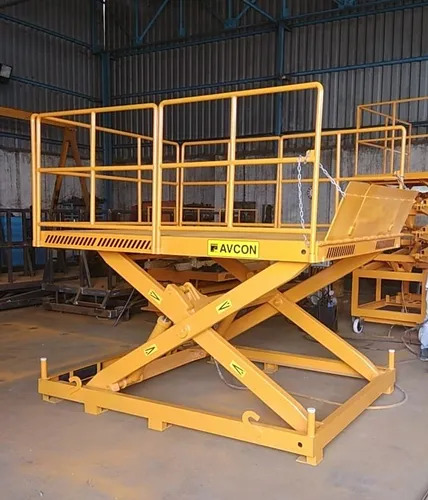
A hydraulic scissor lift is a vertically lifting platform supported by a crisscrossed steel structure that expands and contracts like a pair of scissors. The lifting motion is powered by hydraulic cylinders that exert force on the frame, enabling smooth vertical movement.
Alt Text: Industrial hydraulic scissor lift platform raised in a warehouse.
These lifts are designed to elevate heavy loads safely to different heights, minimizing the risk of manual lifting injuries and enhancing operational efficiency.
How Does a Hydraulic Scissor Lift Work?
Hydraulic scissor lifts operate based on Pascal’s Law, where pressure applied at one point in a fluid is transmitted equally in all directions. Here’s the simplified process:
- Hydraulic fluid is pushed into the cylinder using a pump.
- Pressure increases inside the cylinder, forcing the scissor legs apart.
- The platform rises vertically as the scissor frame extends.
- Releasing the fluid back into the reservoir lowers the platform smoothly.
This combination of mechanical stability and hydraulic power makes scissor lifts ideal for repetitive lifting tasks.
Types of Hydraulic Scissor Lifts
Hydraulic scissor lifts come in various designs depending on the intended application. Some of the most common types include:
1. Stationary Hydraulic Scissor Lift
These are fixed-location lifts used for loading, assembly lines, pallet handling, and height adjustments. They are often integrated into warehouse floors or factory setups.
2. Mobile Scissor Lift Table
These are equipped with wheels and can be moved around the facility, making them suitable for handling materials in multiple workstations.
3. Pit-Mounted Scissor Lift
Installed into a floor pit, these lifts remain flush with the ground when lowered—ideal for material loading and unloading with trolleys or forklifts.
4. Heavy-Duty Scissor Lift Platforms
Designed for extremely high loads, these lifts are used in automotive workshops, steel plants, and large-scale manufacturing environments.
5. High-Lift Scissor Platforms
These offer extended lifting heights for applications such as maintenance, assembly, and elevated picking tasks.
Applications of Hydraulic Scissor Lifts
Industries worldwide rely on hydraulic scissor lifts for a wide range of tasks. Some of the most common applications include:
- Material Loading & Unloading – Lifts pallets, crates, components, and finished products.
- Assembly Line Support – Offers level adjustment for ergonomic working positions.
- Warehouse Operations – Helps in stacking, sorting, and handling goods at varying heights.
- Packaging Lines – Supports workstations requiring height adjustments.
- Automotive & Engineering Workshops – Used for vehicle service, parts assembly, and inspection tasks.
- Logistics & Distribution Centers – Ensures faster, safer material movement throughout facilities.
Their reliability and adaptability make them an essential part of modern industrial workflows.
Benefits of Hydraulic Scissor Lifts
1. Improved Workplace Safety
Manual lifting is a leading cause of workplace injuries. Hydraulic scissor lifts reduce dependency on physical lifting, ensuring safer operations.
2. Enhanced Productivity
Workers can move heavy loads quickly and efficiently, reducing cycle time and improving output.
3. Versatility in Use
From light material handling to heavy-duty industrial use, scissor lifts can be customized to various capacities and heights.
4. Stable & Controlled Lifting
The scissor mechanism provides excellent platform stability even under heavy loads.
5. Minimal Maintenance
Hydraulic systems are known for durability and require relatively low maintenance compared to mechanical lifting equipment.
6. Ergonomic Advantages
Adjustable height platforms prevent bending, stretching, and overexertion—making workstations more comfortable and reducing fatigue.
Key Features to Look for in a Hydraulic Scissor Lift
When selecting a hydraulic scissor lift for industrial use, consider the following features:
1. Load Capacity
Ensure the lift can safely handle the maximum weight required for operations.
2. Platform Size
Choose a platform large enough for your materials without compromising stability.
3. Lifting Height
Select a lift height based on your workflow, whether for loading, assembly, or maintenance tasks.
4. Hydraulic System Quality
A reliable hydraulic system ensures smooth lifting, durability, and safety.
5. Safety Features
Important features include:
- Emergency stop switch
- Mechanical locks
- Anti-skid platform
- Safety rails (if elevated)
6. Installation Type
Depending on your facility, choose between:
- Floor-mounted
- Pit-mounted
- Mobile scissor lift tables
Each setup supports different operational needs.
Why Hydraulic Scissor Lifts Are Essential in Modern Warehouses
The rise of automated and semi-automated warehouses has increased the demand for reliable lifting equipment. Hydraulic scissor lifts are essential because they:
- Support efficient workflow management
- Reduce downtime caused by manual handling
- Improve accuracy during material movement
- Ensure compliance with workplace safety standards
Whether it’s a small manufacturing unit or a large distribution center, scissor lifts form the backbone of seamless material flow.
Best Practices for Using a Hydraulic Scissor Lift
To ensure safety and longevity, follow these essential guidelines:
Routine Checks
- Inspect hydraulic hoses for leaks.
- Check platform stability before operation.
- Ensure safety locks and emergency switches function properly.
Safe Operation
- Never overload the lift beyond its capacity.
- Use safety rails for elevated operations.
- Ensure the working area is clear of obstructions.
Regular Maintenance
- Lubricate moving parts as per manufacturer recommendations.
- Schedule periodic hydraulic system inspections.
- Train operators in proper handling procedures.
Consistent maintenance not only improves safety but also extends equipment life.
Conclusion
Hydraulic scissor lifts have become indispensable in modern industries due to their safety, efficiency, and versatility. They support smooth material movement, reduce manual strain, and provide reliable lifting solutions for a wide range of industrial tasks.
As a leading name in the material handling manufacturing sector in India, Avcon System continues to be a part of this evolving industrial ecosystem, offering insights and expertise that help industries operate safely and efficiently.