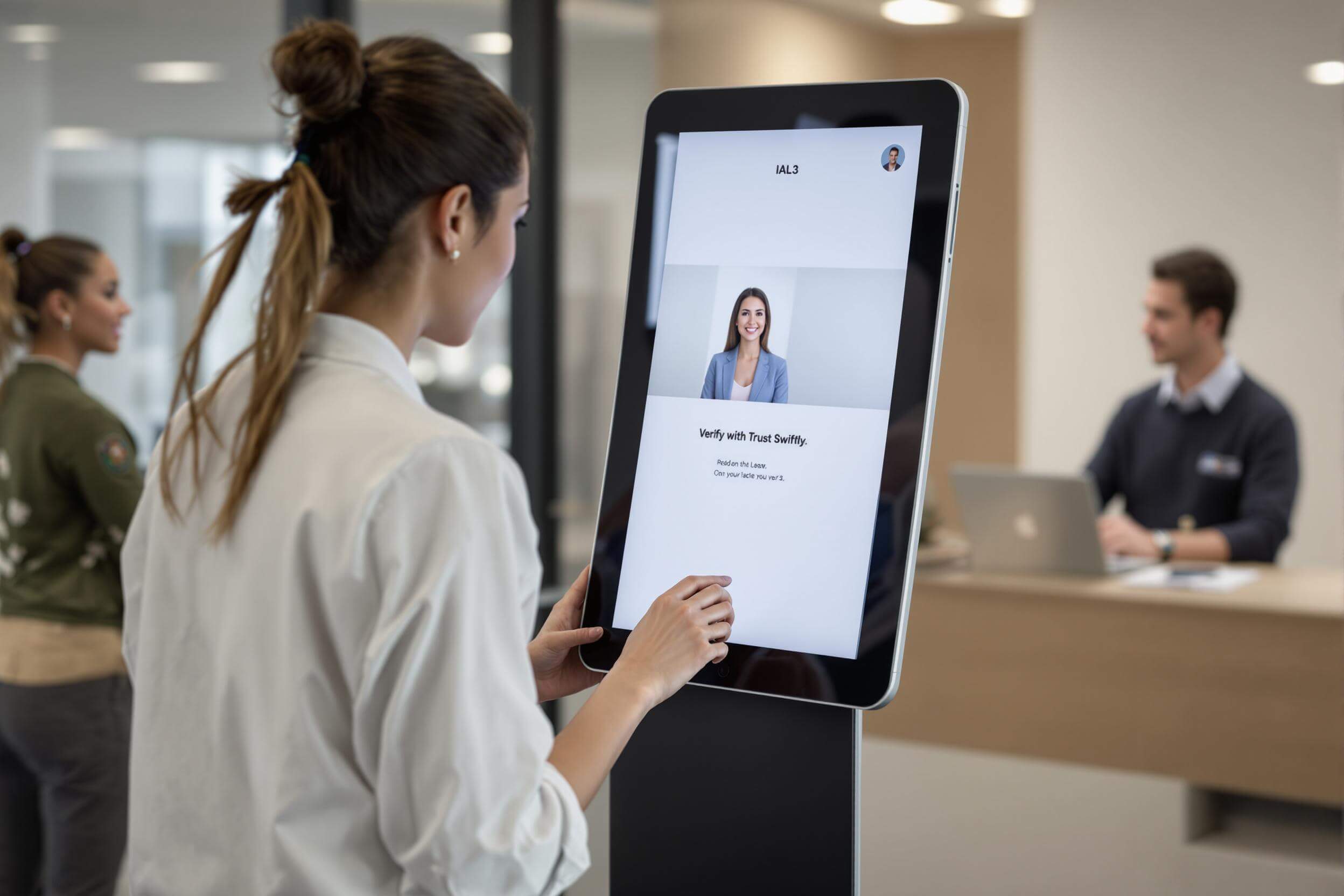
In the landscape of digital security, “Identity Proofing” is the process of ensuring that a person is exactly who they claim to be before granting them access to sensitive systems. To standardize this process, the National Institute of Standards and Technology (NIST) created Identity Assurance Levels (IALs). While IAL1 and IAL2 are common in commercial settings, IAL3 verification represents the highest level of certainty achievable in the digital world.
But what exactly does IAL3 mean for an organization, and why is it becoming the non-negotiable standard for high-security environments?
Defining the IAL3 Standard
Under the NIST 800-63A IAL3 guidelines, IAL3 is defined as high-assurance identity proofing. It is designed to virtually eliminate the risk of impersonation, synthetic identity fraud, and advanced spoofing.
To meet the IAL3 definition, a verification process must satisfy three “hard” requirements that distinguish it from lower levels:
1. Physical or Supervised Presence: Traditionally, IAL3 meant “in-person” proofing. Today, it includes Supervised Remote Identity Proofing (SRIP), where a trained agent oversees the process via a secure video link.
2. Superior Evidence: Unlike IAL2, which might accept a standard driver’s license scan, IAL3 requires at least two pieces of “Strong” evidence or one piece of “Superior” evidence—such as a biometric ePassport verified via NFC.
3. Mandatory Biometrics: There is no IAL3 without biometrics. The applicant’s physical characteristics (face or fingerprints) must be captured and cryptographically bound to the identity evidence.
The “Trusted Path”: The Hidden Requirement of IAL3
The most significant technical hurdle in IAL3 identity proofing is the requirement for a “Trusted Path.”
At IAL2, users are permitted to use their own uncontrolled devices (BYOD), such as a personal smartphone or laptop. However, NIST is explicit: for IAL3, the hardware used to capture the identity data must be controlled. This is because a user-controlled device can be compromised by “Virtual Camera” injections—software that feeds pre-recorded deepfakes into a verification app.
An IAL3 compliant solution solves this by using managed hardware, such as shipped Remote Kits or On-Premise Kiosks. Because the service provider controls the operating system and the camera sensors, auditors have a “cryptographic chain of custody” that proves the data is raw, real-time, and untampered.
Why Organizations are Moving to IAL3
As cyber threats evolve, the “cost of being wrong” about an identity has skyrocketed. Organizations are adopting IAL3 for three primary reasons:
1. FedRAMP High and Government Compliance
For federal agencies and cloud service providers (CSPs) seeking FedRAMP High or DoD Impact Level 5 (IL5) authorization, IAL3 is often a mandatory requirement for privileged users. It ensures that the people managing the nation’s most sensitive data have been vetted with maximum rigor.
2. Thwarting AI-Driven Spoofing
We have entered the era of the “untrustworthy pixel.” AI can now generate convincing live video of a person who doesn’t exist or personate a high-ranking executive. By requiring supervised sessions and hardware-anchored biometrics, IAL3 effectively neutralizes deepfake and injection attacks that would easily bypass IAL2 software.
3. Eliminating the “Retail Kiosk” Bottleneck
Historically, IAL3 was a logistical nightmare, requiring employees to travel to physical post offices or enrollment centers. Modern IAL3 solutions have modernized this by providing supervised remote options. This allows a global, distributed workforce to be verified at the highest level without the cost and delay of physical travel.
The Core Components of an IAL3 Compliant Solution
To be truly IAL3-ready, a solution must integrate several high-tech layers:
· NFC Chip Reading: It must verify the cryptographic signatures on biometric ID chips to ensure the document hasn’t been altered.
· Liveness Detection: It must use certified “Level 2” liveness detection to prove a physical human is present, not a mask or a screen.
· Audit-Ready Reporting: It must produce a detailed, immutable digital trail that shows exactly how the identity was resolved, validated, and verified for 3PAO auditors.
Identity as the Foundation of Zero Trust
In a Zero Trust architecture, the mantra is “never trust, always verify.” NIST IAL3 verification is the ultimate expression of that philosophy. It moves identity proofing out of the realm of “high probability” and into the realm of “cryptographic certainty.”
By implementing an IAL3 compliant solution, organizations don’t just check a compliance box—they build a perimeter around their people that is resilient to the most advanced identity threats of the modern age.