

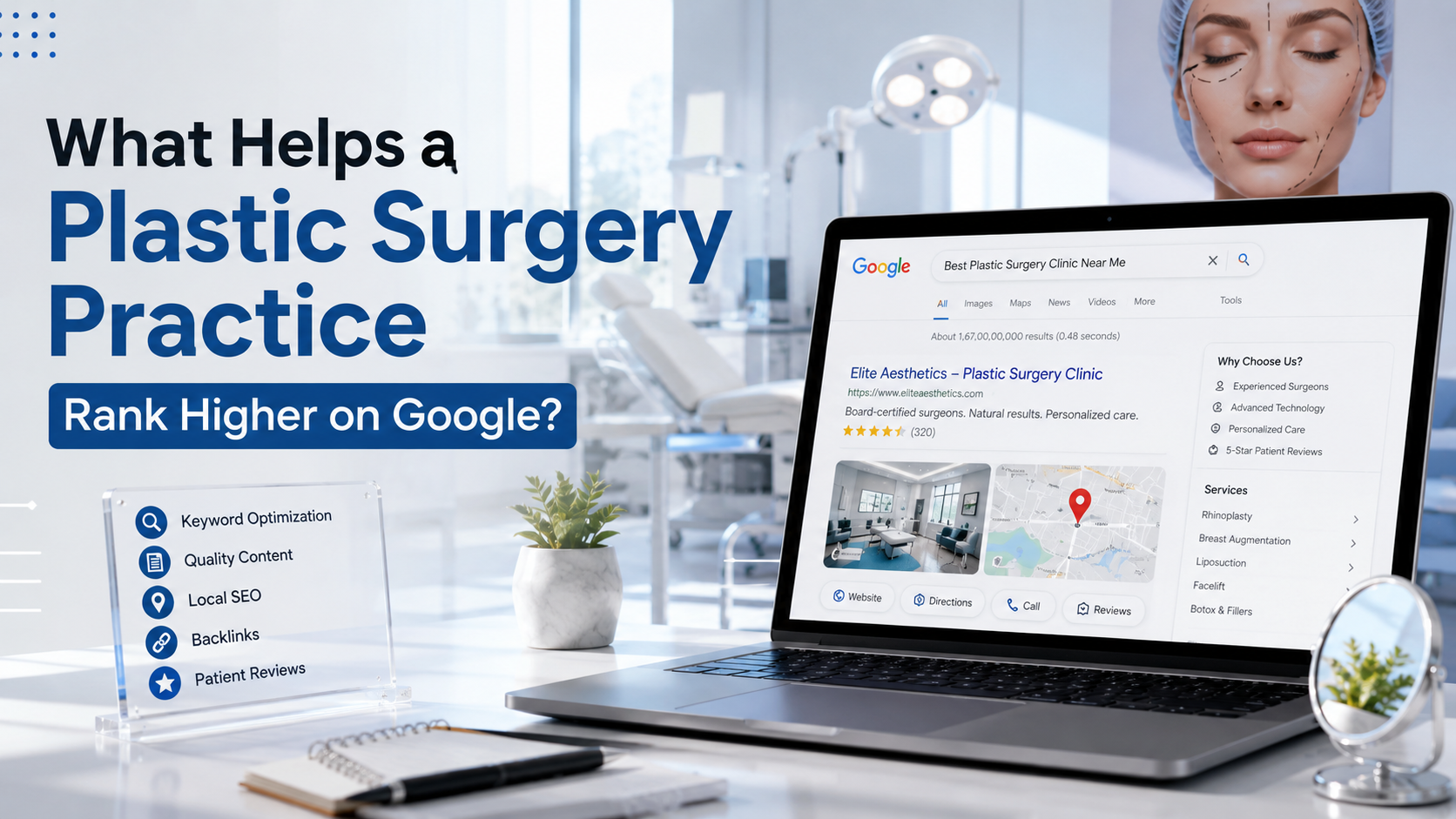
What Helps a Plastic Surgery Practice Rank Higher on Google?
When people are considering plastic surgery, one of the first things they often do is search on Google. They may search for terms like “best plastic surgeon near me,” “breast augmentation surgeon,” “rhinoplasty specialist,” or “plastic surgery consultation.”
If your practice does not appear on the first page of Google, potential patients may never find your website.
The good news is that improving your Google ranking does not require complicated tricks. A strong website, useful content, local SEO, positive reviews, and a good user experience can all help your practice become more visible online.
In this guide, we will explain the key factors that can help a plastic surgery practice rank higher on Google and attract more qualified patients.
1. Create a Professional and Helpful Website
Your website is one of the most important parts of your online presence. It should look professional, work well on mobile devices, load quickly, and make it easy for visitors to find information.
A plastic surgery website should clearly explain:
- The procedures you offer
- Information about each procedure
- Your surgeon’s experience and qualifications
- Before-and-after results, where appropriate
- Patient FAQs
- Your location and contact information
- How patients can request a consultation
Google wants to provide users with useful results. If your website clearly answers the questions potential patients are asking, it has a better chance of performing well in search.
Your website should also have simple navigation. Visitors should not have to click through several pages just to find a procedure or contact form.
2. Use the Right Keywords
Keywords are the words and phrases people type into Google when searching for services.
For example, someone interested in rhinoplasty may search for:
- Rhinoplasty surgeon near me
- Rhinoplasty consultation
- Nose job specialist
- Rhinoplasty plastic surgeon
- Rhinoplasty in [city]
Your practice should identify the keywords that are relevant to your services and locations.
However, avoid filling your pages with keywords simply to influence Google. This is known as keyword stuffing and can make your content difficult to read.
Instead, use important keywords naturally in your page titles, headings, paragraphs, image descriptions, and other relevant areas.
Effective seo strategies for plastic surgeons focus on matching website content with the real questions and needs of potential patients.
3. Build Individual Pages for Your Procedures
One common SEO mistake is putting every procedure on one general “Services” page.
If your practice offers several procedures, consider creating a dedicated page for each major service.
For example:
- Rhinoplasty
- Facelift
- Breast augmentation
- Breast lift
- Liposuction
- Tummy tuck
- Eyelid surgery
- Mommy makeover
Each page can explain what the procedure is, who may consider it, what the consultation process involves, recovery information, and frequently asked questions.
Individual service pages also give Google more specific information about your practice.
For example, a dedicated rhinoplasty page gives your website a better opportunity to appear when someone searches specifically for rhinoplasty rather than relying on one general plastic surgery page.
4. Focus on Local SEO
Plastic surgery is a local service. Most patients want a surgeon they can visit in their area.
That makes local SEO especially important.
Your practice should have accurate and consistent information across your website and online business listings. Your name, address, phone number, website, and business hours should be correct.
Your Google Business Profile is also important. Keep it updated with:
- Accurate business information
- Your website
- Phone number
- Office hours
- Services
- Photos
- Relevant business categories
- Patient reviews
Local search optimization can help your practice appear when people search for plastic surgeons in your city or nearby areas.
For example, someone searching for “plastic surgeon in Miami” should be able to easily understand from your website and business profile that your practice serves Miami.
5. Get Genuine Patient Reviews
Reviews can play an important role in helping potential patients decide whether to contact your practice.
Many people look at Google reviews before choosing a healthcare provider. A practice with positive, genuine reviews can make a stronger first impression.
Encourage satisfied patients to leave honest reviews about their experience.
Do not buy fake reviews or create reviews yourself. Authenticity matters.
It is also a good idea to respond professionally to reviews when appropriate. Thank patients for positive feedback and handle negative feedback respectfully and according to applicable healthcare privacy requirements.
Reviews can help with both trust and local search visibility.
6. Publish Useful Blog Content
A blog can help your practice answer common patient questions while giving Google more useful content to understand.
Think about the questions patients frequently ask during consultations.
Examples include:
- How long does rhinoplasty recovery take?
- What should I expect during a facelift consultation?
- How should I prepare for breast augmentation?
- What is the difference between liposuction and a tummy tuck?
- When can I exercise after plastic surgery?
- What questions should I ask a plastic surgeon?
Create helpful articles that provide clear, educational information.
The goal should not be to write content only for search engines. Write for real people first.
When visitors find your articles useful, they are more likely to explore other pages on your website and consider contacting your practice.
Consistent content creation is one of the practical seo strategies for plastic surgeons because it helps build topical relevance around the procedures and questions your potential patients care about.
7. Make Your Website Mobile-Friendly
Many people use their phones to search for healthcare services.
If your website is difficult to use on a smartphone, visitors may leave quickly.
Make sure:
- Text is easy to read
- Buttons are easy to tap
- Images display correctly
- Forms work on mobile devices
- Menus are simple
- Pages load quickly
A mobile-friendly website creates a better experience for visitors and supports your overall SEO performance.
8. Improve Website Speed
Nobody likes waiting for a slow website to load.
Large images, unnecessary scripts, poor hosting, and unoptimized website files can slow down your pages.
Plastic surgery websites often contain many images, especially before-and-after galleries. These images should be properly optimized so they look good without unnecessarily slowing down the website.
A faster website can improve the user experience and help visitors stay on your site longer.
9. Use High-Quality, Original Content
Google looks for content that is useful, relevant, and trustworthy.
For a plastic surgery practice, your content should demonstrate professional knowledge while remaining easy for patients to understand.
Avoid copying content from other plastic surgery websites. Create original pages that reflect your practice, your services, and the questions your patients actually ask.
You can also include information about your surgeon’s qualifications, training, experience, professional memberships, and approach to patient care.
Healthcare is a sensitive area, so trust and credibility are especially important.
10. Optimize Your Page Titles and Headings
Every important page should have a clear title that tells both Google and visitors what the page is about.
For example, instead of using a generic title such as:
“Services”
you could use:
“Rhinoplasty in Austin | [Practice Name]”
Your headings should also organize the information clearly.
For a rhinoplasty page, headings might include:
- What Is Rhinoplasty?
- Who May Consider Rhinoplasty?
- What Happens During a Consultation?
- Rhinoplasty Recovery
- Frequently Asked Questions
Clear titles and headings make your content easier to understand and navigate.
11. Build Relevant Backlinks
A backlink is a link from another website to your website.
High-quality links from relevant and trustworthy websites can help strengthen your site’s authority.
For example, your practice may earn links through:
- Professional organizations
- Local business publications
- Medical directories
- Community organizations
- Interviews
- Educational partnerships
- Industry publications
The focus should be on quality rather than quantity.
Buying large numbers of low-quality links is not a sustainable SEO strategy. Instead, work toward earning relevant links naturally by publishing useful resources and building a strong reputation.
12. Make It Easy to Contact Your Practice
SEO is not only about getting visitors. The ultimate goal is to turn relevant website visitors into potential patients.
Make it easy for visitors to take the next step.
Your website should have visible options such as:
- Request a consultation
- Call the office
- Contact us
- Ask a question
- Schedule a consultation
Keep contact forms simple and avoid asking for unnecessary information.
A visitor who cannot quickly figure out how to contact your practice may simply return to Google and choose another provider.
13. Track Your SEO Performance
SEO is an ongoing process. You should regularly monitor how your website is performing.
Important metrics can include:
- Organic website traffic
- Search rankings
- Phone calls
- Consultation requests
- Contact form submissions
- Top-performing pages
- Search queries
- Local search visibility
Tools such as Google Analytics and Google Search Console can provide useful information about how people discover and interact with your website.
This data can help you identify what is working and where improvements are needed.
14. Keep Improving Your SEO Strategy
Google rankings can change over time. Your competitors may publish new content, search behavior may change, and Google may update how it evaluates websites.
That means SEO should not be treated as a one-time project.
Review your website regularly. Update old articles, improve outdated pages, add new FAQs, check your business information, and look for new topics that your potential patients are searching for.
The most effective seo strategies for plastic surgeons combine technical SEO, quality content, local optimization, reputation building, and a strong patient experience rather than relying on one single tactic.
Conclusion
Ranking higher on Google can help a plastic surgery practice reach more people who are actively looking for its services.
The foundation is simple: create a professional website, publish helpful information, target relevant keywords, optimize for local searches, collect genuine reviews, improve website speed, and make it easy for potential patients to contact you.
SEO takes time, but consistent effort can build stronger online visibility and bring more qualified traffic to your website.
If you are developing seo strategies for plastic surgeons, remember that the goal is not simply to rank number one. The real goal is to appear in front of the right people, answer their questions, build trust, and help them confidently take the next step toward a consultation.
